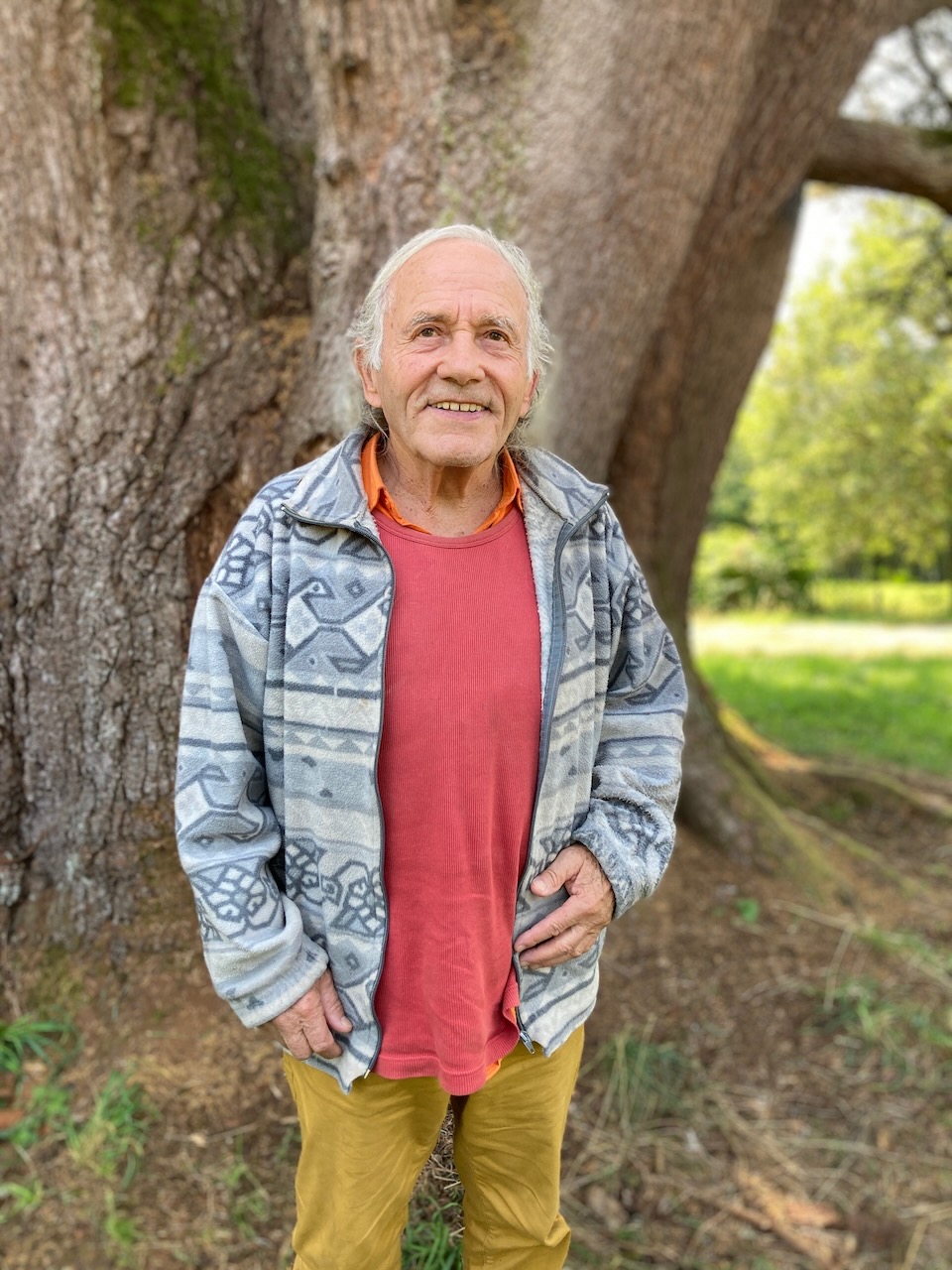
Endnotes (E): Can you tell us a little about when and where you were born, about your childhood?
Camatte (C): I was born near Marseille, [where we lived] let’s say temporarily, in the sense that my parents stayed there for a short time because they had left Morocco and they were looking for... it wasn’t fixed, you know. So I was born there and [early on] I was separated from my mother. She was institutionalised, she was mad. And so, since my father had many children, I was separated from him for five years. I lived in a home for abandoned children and I only rediscovered my family five years later. I didn't see my mother again until I was twelve years old and it was hard because at the time, psychiatric asylums – we didn't even talk about hospitals, an asylum is where you put people you really want to exclude – were dreadful.
My mother was contradictory because, at times, she was calm, kind and all, and then, at times, she went off the rails. Sometimes she was very violent. To see all these people [in the asylum] getting agitated was impossible for me – I was twelve years old. My father went every Sunday to see her, but I couldn't. What was important is not just the fact that she was crazy, but the type of craziness. She was both overprotective and she hit her children. That’s why she was denounced by her neighbours and put in hospital. That was terrible; it has followed me ever since and it’s not for nothing that I tried to understand what madness was. Also, in children there is a mimicry: to be accepted, the child often does what the parent does. And one day I asked myself if I too had gone mad.
This question has pursued me my whole life. When I was with a woman, I was afraid that she would realise that I was crazy. And the more powerful my relationship [with] that woman was, the more terrible that uneasiness was, so I didn't have an easy love life, and [today] I'm all alone. It’s not the women’s fault, it’s my problem that I only understood very late, very late, very late. For often people get into psychology, psychoanalysis, and hear “it’s because of your mother,” but what does that mean to say that it’s because of my mother? What happened? I experienced moments of terrible threat from my mother. And precisely the idea of threat that I have conceptualised comes from there. I experienced impatience, impatience and then the fact that everything is unstable, because she was very good, and then poof! It all blew up.
For example, when I was four years old, in this establishment where I was living, there was sand, there were pine needles, and I was playing at tidying them up. And all of a sudden, I remember looking at my hands and saying: “What are hands for? What are hands for?” and “It’s all in vain.” And what was astonishing to me is that twenty-six years later, when I was in the military service, I was carrying the Bible in my suitcase – it was the only book that [allowed me] to have a great diversity – and when I read in Ecclesiastes, the book of Kohelet – “vanity of vanities, all is vanity!” – I saw that it was the same question I had been asking, which is to say that even theoretically it influenced my relationship to the workers’ movement, and to Bordiga in particular.
What I liked about Bordiga was that he didn’t have a theoretical production that was personal, that was fictitiously Bordiga’s and nobody else’s, he didn’t care about that. He didn’t use everyone else’s contributions to prop himself up, but he rather had to bear witness to everything that these beings had experienced so that it wasn’t in vain: vanity.
So I tried to escape, but that’s where I encountered the repression of naturalness, which led me, when I was seven years old – I remember it like it was yesterday, the room where it was and everything – to say to myself “but why are adults so mean?” I tried to find solutions in poetry, because there’s the incantatory dimension of poetry, then in philosophy, and then later I encountered the Italian left, Bordiga, and there was a solution: wickedness came from the class struggle! So I had to understand that.
Obviously, from a certain point on, that wasn’t a sufficient explanation, and all the more so because it posed big problems, namely that the revolution, of course, will make it possible to realise a society where we can coexist, but the revolution is an act of violence. Bordiga had written in 1917 “war is subhuman, but so is revolution.” And that was the big problem: you make a revolution, you unleash violence.
These things are interesting because [they relate to the question of] the need for a party. For Lenin – this is a dimension that we don't see – [the point of the party was] to control violence. Lenin had a false vision of the peasants – he thought they were barbarians – so that’s what he wanted. Only – and this is something I understood later – you replay it, if you come to it from the root, you replay it. In other words, he himself recreated an absolutely dreadful organism of repression.
So, for me, this was already an element of reflection in relation to that which I discovered much later: the necessity of inversion, to see why I don’t want the revolution. The revolution puts us back into violence; but there is also something else, which is that the concept of revolution implies a return, so we don’t get out, we are trapped, as if we were a rotating star. And so you really have to find a way of life such that you don’t start again. That’s why, at first, I talked about leaving this world - this world we must leave – but then this wasn’t enough because it’s not enough to leave the world, you need positivity: that’s the inversion. So it’s all conditioned by what I experienced.
E: To go back to what you experienced when you were seven: who were these mean adults of which you talk?
C: All adults. I had noticed, with some exceptions, that old people in general were more accepting of children. And so there could be coexistence. But all adults treat you with condescension. They listen to you, but they say, “Oh yes, you’re very sharp aren’t you?”: condescension is frightening, frightening. You never see the children as they are, and then to believe that a child can do something good, can think, no!
E: Where did you live at that time?
C: I lived in Marseille, in dire poverty because [we were] six children. I had six siblings... At the time, there was no family allowance, there was nothing. And there, I recognise that my father took charge, my father and, as always, it was my older sisters who raised me. It’s always the women who suffer.
E: What about the community dimension you often talk about, the fact that you found it hard to leave your family?
C: There was the repression my father inflicted, with all the difficulties that I understand very well, but I was very happy. It’s true what J reminds us of: I left my family at the age of twenty-three because I had to. I was appointed as a teacher in Toulon and I lived in Marseille, and it was a 65 km commute there and 65 km back. At the beginning, I did it every week, and then I couldn't do it anymore. I heard friends cursing the family, but I couldn’t; I was so happy with my brothers and sisters, even if I didn't really get along because we had completely different backgrounds
One of my brothers couldn’t stand the misery and he had to try to skip his class, as we used to say. So he went to Madagascar and there, from one day to the next, he found himself with servants! And I had a brother who was a worker. At the time, he used to leave at 6 a.m. on his bicycle to go to work. There was no shower, nothing, so he would come home in his dirty overalls; and there was a chair reserved for him, because if you sat on it, you almost stuck to it because it was so dirty. I said to myself: I don’t want that. I got on well with my brother, but I didn’t want to become a worker at all.
And I saw the transformation taking place in the working class. In the 1950s, the workers had blue overalls and, on the days when they didn't work, they wore other blue overalls, overalls for going out. And at a certain point, they no longer accepted that. Before, when you went out on Sunday, you could say: “That’s a worker”; afterwards you couldn’t, because everyone was dressed like a bourgeois. It’s something which amazed me, like how, in the workers’ ideology, they said that workers were happy to be workers. No, it was the fact of having this blue, of dressing in blue, which was a mark, it was terrible.
E: So after the army, you became a teacher in Toulon?
C: In the 1960s there was a huge shortage of teachers because the job wasn’t paid, so I could get a deferment. We went from one year to eighteen months, and then even longer. The class of 1956, when they finished, they were recalled and there were very strong demonstrations against that. It was a socialist minister who imposed it, not the right, as they say. And so I didn't want to do that – at the time I was already in the party – so I studied hard.
E: This was the International Communist Party?
C: Yes, it was a small party. I often prefer to say the Italian Left because there must have been maybe a hundred of us worldwide. Small party in number, but remarkably powerful.
E: When did you first come across the party?
C: It was in high school. I had a schoolmate who went out with a girl who was the niece of left communist militants. So he was, let’s say, educated. He was taught about that, and he told me about it; I agreed. We got to know each other at the beginning of October and at the end of the year, I went to see the others. There were four of us, but it was very strong. That's when I started learning about Marxism.
E: Strong in what way?
C: A great theoretical power, but it wasn’t just Bordiga. I had a comrade – Picino, because he was small, about the same size as me, and very, very strong, very powerful – well, he sometimes had a clarity of vision like Bordiga. And on the job, he told me he wanted to read Capital; I said yes. He said, “Will you help me?” I said, “Yes, if I can.” Then he asked me a question, and it was a question about French! He was very, very strong, but he had refused to learn French so he couldn’t do it. But when I told him the concept, it was obvious to him! It wasn't the concept itself, but the words he didn't know.
E: Because you were reading the French edition of Capital at the time?
C: Yes, I read Capital in German much later. But I was amazed, I said: “But Picino, you understood everything, that's not the problem. I can give you French lessons, yes.” And then [we were] very united, that’s the community dimension. In the meetings, Bordiga embraced everyone as they arrived. There were intellectuals, but there were [also] the braccianti, as the farm workers were called. And I remember a farm worker from Puglia who brought an incredible wine. He was luminous.
E: Bordiga?
C: No, that worker. You had to be strong, meetings that lasted six hours during the day and Bordiga spoke for three hours without stopping. He would take his glass – I don't know how he did it – he was drinking and would still be talking. Incredible! Bordiga, in 1924 in Rome, made a speech on Lenin’s death which was published afterwards: Lenin on the Path to Revolution. He was at the window – a huge square with thousands of people – and people could hear Bordiga. He had a voice! He was an extraordinary man, powerful! He had an affection, it wasn’t a simple camaraderie, it was a deep affection. When people saw Bordiga they lit up.
E: So you went to Italy for these meetings?
C: Oh yes, four times a year.
E: How old were you then?
C: That’s from the age of eighteen.
E: From the age of eighteen you would go to Naples? Were the meetings in Naples?
C: No, they were everywhere, all over Italy, just to make it easier to get around. It was rarely in Naples, because it’s very far down. No, in Rome, in Milan, in Parma, in [Acqui Terme?].
E: And you met Bordiga at eighteen?
C: No, I met him later. It was when I was twenty that I went to Naples on holiday to see him.
E: Could you tell us about this meeting?
C: It was luminous. I had seen him at the meetings, but I have a very good memory because we went together from Naples to Genoa, where the meeting was, and we took the train. There weren’t only proletarians, there were some pretty shady guys there. One guy was curious, maybe part of the Calabrian mafia; a guy full of dough, so we ate together in a restaurant and everything. Things are very porous in Naples.
When I went to Naples, I was robbed. I had left my car outside. The next morning, I went and, stupidly, I did what they do in France: I filed a complaint. Bordiga told me: “But that's not what you should have done, you should have come and told me, we would have gone to see.” He explained to me that, when he came back from Moscow, I don't know in which year, with some comrades, there was a comrade who had bought a coat which was stolen. Well, they went and got the coat back. It’s incredible, the human species. I was amazed. It was obvious that Bordiga was not in the Mafia, but things are permeable.
Besides, in Naples – I experienced it myself because I stayed for a while to see Bordiga – if you are accepted by the Neapolitans, you risk nothing. I was distracted, I had taken some money from the bank and left it on my bedside table. I had all the fear in the world, I arrived and it was all there because I had come recommended by a comrade who lived there. So I became a Neapolitan. I still have problems with men. I’m always suspicious when someone says that such and such a person is a bastard; I say to myself: no, I don’t know, it’s you who see him like that, but in fact, what is that man? You don’t know.
E: Do you remember what you were discussing with Bordiga that first time or afterwards?
C: We didn't discuss with Bordiga, we listened.
E: Did he talk the entire train ride from Naples to Genoa?
C: No, there were several of us, so there were discussions, but at the meeting he spoke [for] three hours and he didn't want people to smoke. So there were some who hid, but he sensed it and shouted: "No si fuma!"; and he said that cigarettes were waging a class struggle against the workers. They were destroying their health. He was a character.
E: This is true.
C: Yes.
E: Could you tell us about Bordiga’s attitude to space?
C: The first thing he wrote when Sputnik was launched was that it was not in fact a satellite. And he wrote a text: “The Fraudulent Conquest of Space”. It was only later that, of course, they made [inaudible]. But at the beginning, it was a big propaganda stunt.
E: Was his scepticism due to the fact that he had been an engineer himself and didn’t believe that technology was advanced enough?
C: No, he studied the problem, and he said [inaudible]... which raised problems in the party at the time because there were guys who were mathematicians and who challenged it. And then they also contested – this is terrible – Bordiga's theory on capital because they had put everything into formulas – the whole problem of progress and all – only they reasoned abstractly. The problem with the question of, for example, what I call the escape of capital, they didn’t see it. And in mathematics, it can get through, but then they would have had to have the concept to computerize it, but at the time, moreover, computer science was not... No, no, he was a man... It was a joy in life to meet him.
E: Many of your first writings in Bordiguist newspapers were about colonial questions and Bordiga also wrote a lot about this. Could you talk about the significance of colonial struggles in your earlier writing ?
C: Yes, it was a very, very big problem because the political parties of the left, of the extreme left, had very diverse and very different positions. For example, there were those who said that in Algeria, for example, or in Vietnam, but especially in Algeria, there was no proletariat so nothing would come of it. Then there were others, on the contrary, the activists, who said they “supported” it, but they didn’t just support the fellaghas, as they called the peasants in revolt, but they also supported the leadership which, obviously, had bourgeois positions, if you like.
So that was the problem, and Bordiga wrote a fairly long article in which he said that just because we in the West had reached a certain stage where revolution was possible, that we shouldn't deny the progress of all the other people. So what was the practical position? The practical position was to support the rank and file – I was always in favour of the victory of the fellaghas – but not [inaudible]. On the contrary, [what's] interesting [in] the history of Algeria is that there were two movements which developed: the first, the proletarian movement – because there was a huge emigration of Algerian workers to France – which was the MLTD1 – led by a colourful character, Messali Hadj – so [with them] we could agree; and then there was the FLN. But the FLN came up against the MNA,2 and the fact that the Algerian revolution took so long to grow is due to the fact that the FLN had to eliminate not only the proletarian forces, but the grassroots forces, the peasants at their strongest. It’s also interesting to see the collusion between the French government and the FLN. For example, at one point Ferhat Abbas3 proclaimed the provisional government and the left agreed. What France needed in order not to lose everything was for a government to appear which would put down the proletarians and the peasants and that was the role of the FLN with Ben Bella and all.
There was also the need, albeit very weakly, for a certain return to Karl Marx, i.e. to study the grassroots communities. I tried to do this, but we didn’t have ... let’s say we didn’t have Marx’s total perspective – we were far from that – which was to graft the technical achievements of the West onto the communities; but at least it was this: to glorify these communities, and not the destruction that capitalism had brought. I see a continuity in my journey.
E: So you did these studies deal with...?
C: The little I had. At the time, there was no knowledge, for example, of the famous chapter of the Grundrisse, which was only published in France after 1968. It was a guy from the party who I miss very much, Roger Dangeville, who translated it. We were lucky because Dangeville was in Paris and worked with Maximilien Rubel. Maximilien Rubel was publishing extracts and so he needed people to do the translations for him; not that he didn’t know German, he knew German very well, but he didn’t have the time. So he passed manuscripts to Roger and as he had a friend who, at the time, had a photocopier, he photocopied everything and gave Rubel copies. That’s how I got to know the unpublished chapter of Capital – because Roger and Jacques had made a photocopy and he translated it so I got to know the translation long before it was published by [inaudible]. And so I worked on the whole thing long before it came out, which was lucky. That’s how I developed the concepts of formal domination and real domination by borrowing from Marx: but I generalized them to society. There have been many people who presented themselves as if they were the ones who had done that, it’s incredible.
E: When was the first time you realised that you weren't going to be able to pursue this research within the International Communist Party? When did you realise that you would have to break from it?
C: Yes, but it’s a problem of the party, of organisation. Bordiga's fundamental concept of the party was that, given that the party is lived as a being, there cannot be a democratic centralism – all the more so because he was against democracy – but rather an organic centralism which would be recreated by the life of the party itself. But that was not understood. Many comrades, who were at the same time activists, attributed the fact that we had little impact to the fact that we functioned badly. So there was that; and ... it was linked to agitation too. Afterwards the thesis of those who [wanted] to support the anti-colonial revolutions prevailed in the party but without taking into account the restrictions [I was talking about] earlier. Both of these factors caused the party to break up in the 1980s, but I started out with this issue and it was a text I wrote that sowed the seeds of discord.
In 1961 I wrote Origin and Function of the Party Form and it was in this text that I understood Marx’s concept of the formal party and the historical party. It meant that even if [as] a formal party, that is to say, a present one, [we are only a few], we also exist as a historical party because we are linked to past generations. And that suited Bordiga very well, so he accepted it, but many did not.
Then there was the interpretation of the anti-colonial revolutions, the incredible will to make the proletariat intervene where it wasn;t, for example in India, and one guy wrote that there was a proto-proletariat. I said, “But if there’s a proto-proletariat, it’s because there's a proto-bourgeoisie, and how do you get a proto-bourgeoisie? You need proto-proletarians.” It was really inconsistent. I couldn’t accept all that, and so there was a meeting in Paris – without Bordiga, it was a meeting with others – and it was police style – what’s truly militant and all that – and then I got up and said: “Listen, for me, this is not a party meeting, it's a masquerade.”
They wrote and said – at the time I was called Oscar, when I was a schoolboy, my friends had... well – so they all wrote: “Oscar must be excluded,” and Bordiga said: “I don't know what it’s all about, how to exclude...”. There was a meeting afterwards in Naples where he made some additional theses, but that didn’t solve anything, so a certain number of comrades and I walked out; but it wasn't against Bordiga. In fact, when I sent Invariance to Bordiga, I said: “I'm not leaving the party because I don't agree with you, it’s the opposite.” Because a year before, there had been a whole group from Milan who had left because they wanted to reintroduce the democratic principle. And I remember, they were talking like that and all of a sudden, he took his briefcase, his bourse as we used to say, and stormed off, saying : “Merda sulla democrazia!”
E: You chose the name Invariance to affirm this continuity with Bordiga?
C: Yes, there were two important concepts in Bordiga, the concept of sul filo del tempo, which was the title of a column. When we came out, maybe three or four months later, there was a distinctness between me and Dangeville – there were maybe twenty of us in Paris – because he wanted a centre. I said, “But Roger, we're not going to start again, we got out because of all this bullshit,” so we broke up. And he [and] the Belgian comrades – there was a typographer, an extraordinary man – they immediately printed a magazine which they called Le Fil du temps. So I was there with a guy – there were four or five of us – and he was panicking and I said, “Look Philippe, no problem, there's a much better title, it's Invariance.”
Because in 1953 Bordiga had written The [Historical] Invariance of Marxism, and for me, that’s the interesting concept. It’s very interesting because at the same time, historically speaking, I realised – and I spoke about it – that the Shiites had the same position: you don't change, it’s the book, you maintain the book; it’s extraordinary. And they maintain the book because it’s the only element which they can rely on to resist, to live. Marxism wasn’t just in your head, it was also the possibility of surviving this counter-revolution, because it was terrible. When you spoke with people in the 1950s, you only met Stalinists and they were on the verge of smashing you in the face. Those were terrible times. For me, that was invariance... but afterwards, I obviously gave it another content.
E: One of the concepts that has remained invariant across all your writings is of course that of Gemeinwesen and the community. Could you talk about how and when you came to see the centrality of this concept in question, the Gemeinwesen ?
C: While the concept of invariance comes from Bordiga, it was I who updated the concept of Gemeinwesenand, incidentally, that was also one of the causes of my exclusion. Because I read the 1844 Manuscriptsand the famous notes to James Mill and, precisely, for me, they were all elements of an attempt to say what the conduct of party members should be. Because there was a contradiction in the party. Bordiga said that we had to behave as if the revolution had already happened. But how do you do that? I tried to look to Marx and I came up with this concept of Gemeinwesen. But there was another problem that was difficult, and that was that if you make the party into an entity, the party member is nothing, and that was an obstacle.
The idea that I had in relation to what Marx posited was that, in order for there to no longer be a need for mediation – in particular on this question of centralism – what is it that is needed? It is necessary that individuality itself must have the dimension of Gemeinwesen. At that point, there is no longer any need for mediation. In that case we wouldn’t need to talk about it, it wouldn’t be appropriate. And so, afterwards, I delved deeper and found in Marx’s work the term Gemeinwesen, not only in his early works, but precisely in the forms that emerge from there... these are the forms of Gemeinwesen, the forms of community.
E: It wouldn’t be appropriate even for Bordiga?
C: No, as far as I’m concerned, Bordiga [maintained] a certain rigidity on this because he considered that the cause of the defeat was the cult of the leaders; so we shouldn’t talk about leaders. But that went so far as to deny the individual. That’s the only point where I disagreed with him. Because afterwards, it’s always the same, you had people in the party who took advantage of that to assert themselves, and then if you asserted yourself, then you were the one taking an individual stance, you were an individualist. It was crazy. So I said, I don't want to live like that, that’s not communism. There are some really, really important questions.
E: In our discussion R remarked that in your writings, you generalize this concept of Gemeinwesen to many eras, but in the eras that precede the creation of the West he doesn't really find a Gemeinwesen, and so he wants to know if it’s a universalizing concept?
C: It’s true that the big problem, and already in Marx, is to study the primitive community or Gemeinwesen by itself. But there always remains in men, even in the most degraded communities, this naturalness of the Gemeinwesen. That’s why, when there were the suburban riots in 2005, I put up Marx’s text. He says that all riots are born of the intolerable separation from the community, from the Gemeinwesen; that is to say that when people rise up, they rise up on the basis of the separation from the community, which is at the same time the separation from themselves. Because otherwise, it comes down to this, if I don't have the dimension of community, I cannot; so when I need community, I need to find the dimension of community in myself.
I was criticised in particular by François Bochet – I heard it by ricochet – he said: “what, they were burning cars, they were ransacking!” But yes, they were doing horrible things, but why were they doing all that? It’s the unbearability of being separated that does this, that makes the most horrible things happen. Yes, that’s why it’s a concept, but it doesn’t remain like that, which also makes the concept of Gemeinwesen completely linked to the concept of invariance.
E: To clarify R's question, I think he meant that in the so-called primitive communities there are differences, there is not something that connects these communities, it’s as if they were all autonomous islands with their particular evolution, not universal; whereas there is something universal in the concept of Gemeinwesen. What do you think about this? Would you say that the primitive community is something other than the Gemeinwesen? Does this mean that Gemeinwesen concerns an evolution towards something else?
C: In the last two chapters of Homo Gemeinwesen, I tried to find out precisely under what conditions the human species could have appeared, given that the human child is very vulnerable; and there are two phases: a uterogestation phase and another one, which I call “haptogestation,” but which Ashley Montagu – an American theorist, who wrote a book on touch that is absolutely magnificent – calls “exerogestation.” And this combines with other remarks, for example the psychoanalyst [name inaudible] says that the human child must be carried constantly, at least until the age of two, which doesn’t imply that the child, at times, doesn’t need to get down, to crawl on all fours, but it is the child who does it, at his or her instigation. Then, at a given moment , she hops back into the arms.
It was the Germans who developed the concept of Tragling, from tragen, which means “to carry”, and they consider that the human child is a nidicole, it is in a nest, and that is the child’s nest. And how can we carry the child all the time, if it’s not all members of the community that carry it? There's a remarkable American primatologist, Sarah B. Hrdy, who wrote a book called How We Became Human, and who finds this and develops it, because the problem for women [is this]: she says she was studying and then, damn it, she’s pregnant and she can't continue, whereas her husband can. And that’s when she said to herself that we would need allo-mothers – that means other mothers – so that, in fact, at that moment, she could study, since she wouldn’t be the only one to be the mother of her son. I think that's great.
Sarah Hrdy also saw the essential role of the grandmother: she says that the grandmother is the one who reassures the mother and so on. She interprets the community dimension with the concept of separation, but she feels something, it’s great. So all the women in the community could carry the child. And what was also great was that the child would then have an enormous community: it’s the whole community. If there hadn’t been this very powerful community with a determining role for the sexual relationship, that is to say that it allows for continuity in diachrony, but also in synchrony, because the sexual relationships between men and women allowed for the reconstitution of continuity ... Not like the proles of the 19th Century who wanted the community of women in order to be able to make love, that’s not the question; the question was that this dimension of love made it possible to strengthen ...
So, for me, the Gemeinwesen is that, but I deduce it from this whole movement and I put it precisely in the last chapter.4 And I took as an example something I didn't think I would mention: I read a book by a French prehistorian called La Venus de Lespugue revisited ... One of the things she says already is that [the statuette] is not a Venus. Venus is a concept that has nothing to do with it. It’s not a deity because this statuette is between 15,000 and 35,000 years old; no, it’s a woman. So the first extraordinary thing about this statuette, which had been seen before, is that it is like a playing card: if you see it from one side, you have one character, if you turn it upside down, you have another. But this ingenious woman and [inaudible] wasn’t satisfied with that: she measured the ratio of the breasts – because she has breasts up to that point [gesturing to his waist]. There's also the fact that there are twists that can be interpreted as a loincloth when the statuette is placed on one side and, inversely, as hair.
But instead of leaving it at that, she turned the statuette around and realised that it represents all of life. ... She leaves the door open in the sense that, for her, it can be a man or a woman. So when she turns, at the beginning, it’s birth: the breasts all the way down and the blossoming of the woman. These breasts down to the bottom, these ptosis breasts as they say, are testimony to the power of life because she was able to nourish. So it has nothing to do with the concept of [Venus]. Then there is the child who grows, after she has given birth, there is a representation of death, but we turn the statuette [and] there is birth again. These are all phases of life, it’s something extraordinary. Through this statue I feel the continuity of the species.
Lespugue is a two-hour drive from my home and with two friends I hope to go there, but with this story of covid... because I'm going to go there the day she gives a conference. What’s extraordinary is that she herself lives in Lespugue, and so I'm going to go and see her and simply ask her this: since there are others – what's called the Venus of Willendorf, and there are many statues like that – does she think that these would be similar kinds of statues? And at the same time, what is extraordinary is that it is not something to be looked at, to be admired or put aside, but something that allows us to live, and it’s reassuring. Men and women, by handling this, put themselves back into the cycle of life, it’s something unheard of. Well, I don't know why I was saying that, I’ve digressed ...
E: That’s OK. You said earlier that you were dissatisfied with the concepts of psychosis and neurosis. Can you talk a little bit more about ontosis and speciosis, how you came to see these as necessary concepts, and how they relate to the concept of the invisible?
C: This is the whole problem of madness. We could even start with the notion of being, a philosophical term. An American, Daniel Everett, wrote a magnificent book on a South American ethnic group, the Pirahãs. Well, they don't have a concept of being. Someone is if he appears, so he is if he emerges from the invisible. When he disappears, he is no longer, but he still exists because he can reappear, and I find that extraordinary.
So these concepts of speciosis and ontosis are linked to the fact that what affects the species is its being in its totality, and therefore its totality also involves the invisible; the human species having risked being destroyed. Then we rely on what I call the supernatural – everything that is non-visible – and it is from this force in the invisible, in the supernatural, that everything will be built. But it's obvious that this thing is subject to deformation given the life of the species as we know it. And so, this is where speciosis is constructed, that is to say, adaptations to the artificiality in which the species places itself by leaving nature, which obviously has repercussions on the individual itself, on ontosis.
This is necessarily parallel to the study of how we leave the community where there is continuity for a world where there is discontinuity. This is the study I’m doing now, in particular by studying Greek philosophy: how the thought of the discontinuous imposed itself. And the thought of discontinuity also imposed itself through economic phenomena: it is the movement of value. Because, for there to be value, there must be measurement, and measurement is the capacity to derive the continuous from these discontinuous elements, to recreate an artificial continuum. All this is linked.
Speciosis is not something that is added on, it is created at the same time that we leave the community, as all these communities develop afterwards in the struggle, in the struggle between men and women. So, there too, the invisible, is linked to it all the time. But what I find essential is to rely on the invisible. And that’s why, in my opinion, the relationship to religion should no longer be seen simply in terms of Marx’s vision. For example, the human being, this man or this woman who handles this statuette, is in continuity, they are in eternity, there is no time, there is no space. So how did it come about? Obviously, it took millennia. But here we are. When I think in the discontinuous, my eyes moisten. I can’t, I have to find the continuity. Now be careful, there is a problem and it is: how to handle ourselves in eternity? That’s why men have invented time and space. But these are tools, they are not things that exist, just as the hammer does not exist in nature, but there is everything there to make a hammer. So after that, it’s that we’re trapped by what we’ve invented. We talk about time, that time is shrinking, that makes no sense, it makes no sense! What shrinks or lengthens is the duration of a phenomenon. But here again, these are concepts according to general equivalents. If I had to talk about all durations, I wouldn’t be able to do it, but if I have the concept of time, all durations refer to this concept. This is a huge thing.
E: So what is death if we are eternal ?
C: We are not eternal, it is not the same thing. We live in eternity, but eternity is made up of life and death. And it is because I die that there is eternity. It is not the same thing, no. And also, we have to take into account two extraordinary faculties: imagination and conceptualisation. Through imagination, I can refer myself to inner eternity and when this is not possible, I conceptualise, I go even further. And that's how we can understand this fascination of astronomers to see what happened, with this idea that there was a moment of birth. For me, the Big Bang is not birth, it is a moment in eternity. What is also extraordinary is that it reinforces my love for the earth because only on this planet, not only us, the human beings, but the whole phenomenon of life is something extraordinary. And so by living all this, I fill myself with something. What is hard in death is not death, it is not having lived. But if I have lived my whole life cycle, [it’s like] the statuette: I arrive at death, but we turn, there are other living beings. And so it’s extraordinary.
E: To come back to Invariance, the journal, could you talk a bit about the different phases, its development? There are five series, right?
C : There are five series and then I could have made a sixth series with everything that is on the website.
E: Let’s begin at the beginning with the first series. What was your motive in publishing it?
C: Yes, the first moment is, here I am, I'm leaving this party, [inaudible]. So first of all, it was to show that this party – even if I leave it – did not exist in vain, it testified to things. So I tried to deepen Bordiga’s work and to publish theses that had not been published. It’s a whole period that goes from, lets say, 1966 to around 1970. But there it raises something, it’s that I think the revolution is over, the phenomenon of revolution is over, and that we have to find something else.
E: What year was this?
C: It’s the whole 1970s, when I wrote, for example, the texts Ce monde qu'il faut quitter and C'est ici qu'est la peur, c'est ici qu'il faut sauter5 to show the development of capital, how it leads to the end of the proletariat, etc.; which brings us to the 1980s. Marx said that if the curve of the unproductive became stronger than that of the producers, of the proletarians, it would be the end; and this happened in 1956 in the United States. The repercussions weren’t immediately apparent, it took a few years, but in a very short time we Europeans saw it and then we experienced it ourselves, it happened again. So at that time, not only was there research on capital and everything, but the problem arose [of knowing] why we had arrived there. That’s when I met people who were followers of Alice Miller, who highlighted parental repression, and a small group was formed. We practised [inaudible], that is to say that in order to free ourselves, we had to relive our traumas. And so it was powerful because when we did it with ten, fifteen people, the power it [had] was unbelievable.
E: What was the practice of this group?
C: Well, it was that, for example, the group forms and someone isn’t feeling well, and the simple fact of being there and [telling oneself] that it’s little by little.... everyone listens to him, some will even be able to intervene by saying to him “go on , but be careful, you are no longer there in your past, you are in...”. It’s a very interesting and powerful thing and I understood that it was the strength of the community which did that too, it’s the individual... And so I started to study this and to integrate it into the Marxist perspective. I didn’t want to, let's say, become simply a therapist, I wanted to integrate that but to arrive... So I did that for two or three years but I separated from them because they mythologised consciousness, and for me, consciousness doesn't exist, there are only conscious states. So I kept on good terms, but I didn’t go anymore; I continued on my own.
And then, what bothered me deeply, what I experienced as an enormous contradiction, was ending up in a demonisation of the parents, which meant that in the therapy, one had to separate, almost kill [the parents], at least symbolically. I said: no, that's a contradiction; what I have to do is understand that if my parents did that, it’s not because they were nasty, it’s because they themselves had suffered something and reproduced it. So, to the same extent that I try to find continuity with myself, I have to find continuity with the naturalness of my father or my mother.
So at that point, yes, [inaudible]... I reproduce, I reproduce! So I no longer have contact, [I maintain] friendly relations, but that’s all because I can't talk to them about it. Yet I saw that the same process is valid for the species: it is haunted, it is haunted by something. I don't know who I was talking to about the coronavirus, I made the connection with what Antonin Artaud wrote about the plague: he makes the virus a psychic entity. I said, but I'm not in favour of saying that the virus is a psychic entity, it's the opposite: there is a psychic entity that haunts the species and it will be seen as a virus, which is reality. That's why I studied psychology.
I took up the study of Freud to see what was essential in Freud and from the beginning I was astonished that people say that Freud, for example, discovered repression. He didn't discover repression, Freud discovered the repressed. That is to say, there was a woman called Bertha Pappenheim, a remarkable woman who, according to Freud, said that she coped by ‘cleaning chimneys’. What was that, in fact? At one point she showed them what it was and they saw a repressed sexual act. So what was being witnessed there was the repressed, and to understand why there is this repressed, there had to be a repression. This is already a different dynamic because otherwise, repression is posed a little too abstractly; no, it’s something very concrete. And then it is obvious that repression reproduces itself. As long as you haven't relived the thing, every time you get close to this phenomenon, you close yourself off. And this is also an important concept, that madness is a shutting-in [enfermement].
E: Was it during this research and your relationship with the group of people around Miller that you discovered for yourself the things you were talking about at the beginning, about the relationship with your mother, your sisters, your brothers?
C: Yes, it was a starting point, but in fact it was later that I got there because it took time to find that, in particular to understand why I was alone, without my children – it was too terrible – and without demonising my wife, my ex-wife, although objectively, it's something terrible she did to me. To understand what she went through herself, it also forces you to try to see what the other person went through in order to... otherwise you just make her the fixation point of a male, that’s not right at all.
For me, what saved me from this purely therapeutic dimension was to try to understand how things happen at the level of the species, and not to remain at the level of the individual. Then we can understand how the species re-enacts... I always give the example of the United States, which is an extraordinary case of the threat. The thirteen states, at the beginning, lived under the threat of the Indians, the threat of the French, the threat of the Spaniards, the threat even of the English since the English burned New York until 1819. So there is a rather extraordinary phenomenon to see [and that is] how [during] the whole of the 19th Century, they would separate themselves from the world. This will be the famous Monroe doctrine. Then they’ll get caught up in the First World War, they’ll go back to those horrible Europeans and, as a result, there will be threats again and it will be the Hitler threat, it will be the Soviet threat, it will be the Islamic threat. They're reliving this, it’s really extraordinary. So to simply see shenanigans with the Islamists or whatever, it’s not enough, we have to go deeper. And at that point, we all find our humanity because, like the Americans, we also have our threat. It seems that even in the 19th Century, the English were building forts because they were afraid of a French invasion, but the French would never have been able to do it: on the sea, the English had undeniable superiority and, on top of that, they were helped by the famous story of the invincible Armada. But why? Because, in fact, all these peoples settled in England and others came to supplant them, so there were always threats coming from the sea. It’s fascinating.
E: In the first phase of Invariance there are some important concepts, for example real domination and the material community of capital. Can you explain these concepts and, in particular, why you translated the German concept of Subsumption as domination?
C: Yes, because, for me, the active phenomenon is capital, not the worker, so it's domination that must be put forward. On the other hand, the operaists preferred to use the other term [submission]. And then what is very important is [to ask] how far this domination goes. [There is] this text by Marx, this heavy text, where he develops another form of presentation of the genesis of capital, and it is there that he poses the question. He says [that] value arrives at universality, but it doesn't arrive at community because community is something additional; that is to say, there is the multiplicity of beings, the totality of beings, but afterwards, there is still community: it is what creates the link between everyone as much between the multiplicity of the base as the elements at the beginning and everything, therefore the totality.
And here he makes a development which proves not only that capital will dominate men, but that it will dominate their entire lives, and that it will replace the old community. To distinguish this community: it’s not the Gemeinwesen, it would be a Gemeinschaft, but it's not a Gemeinschaft because it doesn't have a spiritual dimension; what's going to make the community is capital, so it's a material community. Because there is also this very complex thing, which is that capital was built both against value and against the state. It was people who put money aside, who made this famous accumulation, and then they bought the tools and they bought the labour force. They were entrepreneurs. And they were against value, i.e. the bankers etc. What’s going to happen is that it's not enough to produce. Marx studied circulation: it takes four weeks to produce something, for example, but if it takes sixteen weeks to recover the value advanced which became capital a month ago... what do we do? And that's where credit comes in. Credit had to be perfected, which means that, for Marx, credit has a capitalist dimension. Moreover, there is the famous Crédit mobilier [?] in France [inaudible]. And it's only afterwards that, since capitalist credit properly speaking is not sufficient, all the value that had been accumulated previously could be used in the production process. And this is also important, but it's terrible, because, for me, Marx made a mistake: he talked about the accumulation of capital. Because it's not capital that's accumulated, it's the value that's internal to capital. In addition to that, the concept of accumulation is anti-capitalist because when capital accumulates, it is because it cannot circulate, so it no longer exists as capital. This is determined by the fact that he was obsessed by the idea that it would be the act of saving, abstinence. But in fact, no, he's wrong there, and Weber's thesis is more accurate, and it's a continuist thesis: these people wanted to save themselves, so they want to verify that they're saved by the work. If I do something and it succeeds, it's because God wants good for me. I say it's continuist because you can see that it's something that the species pursues. Capital is not born like that, brutally; no, it's all the English Puritans and so on who have made... and individualism against the State.
E: Against the state in what sense?
C: It's because they don't want to be controlled by the state. And capital will seize the state, not to have a state, but in order to keep the power of the proletariat contained. When the proletariat wants to become forceful, well, the phenomenon that occurred with the absolute monarchy will occur, where the bourgeoisie and the feudalists [inaudible] and that allows the king to dominate. Here it's the same, but things don't stay like that, so that, little by little, capital develops, the strength of the proletariat diminishes, etc.: this moment is the moment of the “new”. That moment is the welfare state.
But [once] capital has achieved this it doesn't care about all that and that's why we talk about [inaudible]. They bring in ethics, morality, and all that, but it was logical, it was inevitable. And on top of that, with the disappearance of the proletariat, the condition of working people is getting more and more horrible, more and more horrible. And it's not because of the United States. This is the tragedy of our time and that's why, in capitalist society, the state tends to disappear in the following way: that is to say that all state functions are taken over by companies, it's as if the state was diffusing itself in an enormous network. And as I was saying the other day, the example of Google is terrible in that it takes over everything, even state functions, currency, but it does so on the basis of the entire planet: it's annihilation. There's something enormous about it that can't be separated from the problem of covid.
E: So in the first series of Invariance, you introduced Bordiga to France and in the second, you criticised the concept of revolution. The end of revolutions is an interesting moment because it opens up a whole possibility that I think you talked about in the third Invariance series: the potential death of capital.
C: I said it’s the potential death of capital because it wasn't fully realised. The potential death of capital was related to what I said before; that as a result of the enormous development of automation and the increase in the circulation phase, the quantity of labour power has decreased. What is capital? Capital is a wage relation and it is the genius of Marx to say that behind all relations between things there are relations between people. And so, capital, which is that relation, disappears; but that’s where it was necessary to continue. What disappears is this materiality, but the capital-form continues, since the capital-form, as Marx says several times – the K which becomes a K + ΔK – becomes autonomous and determines our entire reality; it is, let's say, substantialized with innovation.
We can't [leave it at that], no, we have to find something else, hence a hypertelic development, i.e. one that goes beyond what was... I’ll explain: certain biological characteristics can become so important that they will get in the way. This is the case of the large deer in the peat bogs. The antlers had become so large that they could no longer get through the forest. There’s a kind of autonomisation of a phenomenon and it is beneficial and beneficient, and then, at some point, it... Well, this idea of a hyper-telic development is indeed the case of capital. And as we've seen, it concerns all men with the story of augmented man etc.. It's like a prop for a human megalomania to come true. And then we find everything up to the coronavirus because we can ask ourselves the question: isn't the coronavirus there to stop human megalomania? There is an incredible possibility in approaching the question [in this way].
E: But why potential death then?
C: Potentially, because it was happening , but hadn’t yet fully materialised . The potential for this death of capital is this curve, this increase in the number of people, what we used to call the middle classes, but it hadn’t reached a stage where we could really detect anything. So later, I went from potential death to actual death, but at that point, I was able to talk about the autonomisation of capital, the escape of capital, which I had already discussed before.
E: What then led to the last two series of Invariance
C: The last series, the fifth, is where I ask myself the question of finding a psychic foundation for this development of... I've come to think that capital is always a response to this question of threat. Capital was supposed to guarantee our security, prosperity, and to ward off this very threat: we no longer risk anything. In fact, as always, the opposite has happened. That's what I tried to develop in the fifth series, and to do that I had to find a psychic basis. In discussions with comrades in 1973, we even [wondered] if the species hadn't tried to exteriorise its brain by producing capital; and there is an element of truth in the dimension of information technology. I looked at possible avenues.
E: What about the fourth series?
C: The fourth one is Emergence of Homo Gemeinwesen and it's not finished yet.
E: Because it is an emergence...
C: Because I've covered let's say, up to chapter 9: value. I have to finish the following question: how does value affect the process of knowledge; that is to say, how does one go from continuous thought to discontinuous thought? So you have to look at all of philosophy, it's incredible... and then [you have to] also take into account the reactions to becoming, that is to say the men and women who have not accepted the discontinuous... it's complicated. And now I'm on chapter 10, out of 15, it's on the enslavement of women. Two things to explain: the enslavement of women and misogyny.
E: And where in your view does misogyny come from?
C: That's the whole problem of the distribution of the community in the Neolithic period, with the appearance of private property and the contestation of power because – it's extraordinary – women already had power and then, by finding agriculture, they gained even more power; and so it's a dynamic that will lead men to enter into a struggle and finally supplant women. But what’s also happening is the dissolution of the community: the relationship between mothers and children are dissolved, which means that, more and more, children are separated from their mothers and so they experience something difficult.6
[This is where] the ambiguity appears, which is another fundamental concept of speciosis: that the mother is the totality of happiness, the door to everything, but at the same time there is something wrong: it’s a repression, the repression of naturalness. In men, this will reappear later – how? – in the hatred of mothers. There is a text, it seems, by Goethe that is absolutely extraordinary on mothers, which I also know thanks to an American psychiatrist, Lederer, who wrote The Fear of Women. Now all he describes, in fact, is not the fear of women, it’s the fear of mothers. But obviously, when I'm an adult, this fear that I still have makes me hate women. So it's something very deep that we have to get to and that can only be resolved if we simultaneously resolve the relationship to the child. Discontinuous thinking makes it seem as if there were the father, the mother, the child, but no, it’s a whole, and that’s what I want to show.
E: Can you say a little more about the emergence of Homo Gemeinwesen?
C: The emergence of Homo Gemeinwesen is linked to inversion, that's clear. Inversion is precisely about regaining continuity with nature, and therefore eliminating all enmity. This implies another process of knowledge because the process of knowledge has developed precisely to explain our wandering, but also to justify it, and to justify is to make oneself secure. So we need this, we need the relationship between men, women and children, and it involves everything, the inversion of the entire process.
The big problem is precisely to think in continuity and, at the same time, to no longer separate thought from the rest. That's why, for example, I don't use the terms consciousness, mind, and all that – I've been discussing it over the last few days – because, for me, the essential thing is thought, and thought [begins with] affect. We are affected by something, there will be an emotion which will occur, and there’s a whole development which means that at a given moment, we will arrive at reflexivity. When I think, it's [with?] my whole being, because if there's no affectation at the beginning, there won't be the final reflexivity, and that's huge. It also implies the psychological data, to find the continuity in oneself. For me, it's essential when I'm in continuity like that, with you and the trees, I'm indestructible because you can't destroy continuity.
E: In a short article about Giorgio Cesarano you say that he influenced your concept of Homo Gemeinwesen, but that at the same time you didn't necessarily agree with him. Can you say more about this?
C: I was never influenced by Giorgio on the concept of Gemeinwesen. What interested me in Giorgio was an approach, which he made before me, on the psychological dimension, the biological revolution – I don't remember the elements – but I was dissatisfied with it because Giorgio remained in the struggle and then his whole story about the tool bothered me.
E: Why does it bother you?
C: Because the relationship to technology, to the tool, when analysed from the whole perspective of the species, is not something that separates. The tool is what allows man to better articulate himself with nature; in that sense, it’s important... A man who has influenced me enormously and whom I adore a lot is André Leroi-Gourhan, Le geste et la parole. [There is] this dynamic that he describes: the mouth lacks the possibility of a certain concretisation, but speech allows it to compensate. And I always quote this text by Fénélon, Le dialogue des morts. Achilles and Homer meet in the underworld, and Achilles [inaudible] and Homer says to him: “Be careful, it’s true what you say, but if I hadn't said it, no one would know.” The dialectic is constant between... The famous story-telling in advertising, what is it? A company, instead of selling its products, tells its story and therefore it's not the doing that is [inaudible], it’s the way I produce, why I produce for you and so on, it’s extraordinary! In a way, [it's] even with Trump when he said: as long as I say it, it’s a truth. But that's it, reality is not what counts, but me, what I say! It's incredible.
E: Can we understand the idea of emergence and birth as an alternative to the concept of struggle? Can they be understood as the same thing as struggle?
C: It’s not emergence; at that point, what would arise is inversion. Instead of asserting oneself in struggle, that is to say in the negation, what for me will be fundamental is affirmation. We’re here, we’re discussing, I'm not going to introduce myself by saying “so-and-so said that, but that’s not it, that’s not right ...”. No, I say how I think and if I think that, it’s because I’m dissatisfied with what others have said, but I’m not going to deny it. If John thinks differently, it’s because he has another way, that’s what we have to see, it’s nothing else. If I say: no, he hasn't understood anything, then that’s struggle. But no, I affirm, it changes everything... [it’s about] replacing negation.
It [negation] exists, it’s necessary sometimes. You say to me, “Is there anything there?” I say, "No, there's nothing there," because there is indeed nothing there. But when I deny something in you, in fact, there is something [there]. It’s this thing that bothers me. And this is important because, for example, the whole philosophy of Hegel is negation, the power of the negative and everything. But Hegel, at the same time, was a thinker of the discontinuous and he tries to impose another continuum with the absolute spirit. It’s a really simple everyday problem: I affirm myself and I listen to you, and be careful, listening is not accepting, listening is really, literally, taking into account what you said, trying to understand it to the end. If I accept it, I’m probably resigning, I’m no longer myself, and you can't affirm yourself either. But if I affirm what I say and listen to you, there is the possibility of enormous enrichment.
E: This week we have talked a lot about the relationship between certainty and continuity. Can you explain this relationship?
C: Yes, because if I'm in continuity, I have certainty since all of that grounds me. Whereas if I'm in discontinuity, I always have to find something to justify this discontinuity that appears. Whereas here, every time someone asks me a question, I can say it because it's a continuum that passes through me.
E: You said that certainty doesn’t mean that we can know everything nor make no mistakes. What does that mean?
C: It's like the relationship between time and eternity: there's certainty linked to continuity, but uncertainty, doubt, is a tool to arrive at new knowledge. That’s Descartes. That’s just what he says, but it's to arrive, basically, at finding continuity; otherwise, no. Moreover, I think that it allows us to justify changes in position: people who are totally on the left and then move to the right, because they are not sure. And they justify everything; I've often heard "only fools don't change their ideas". But no, I say, it's that you didn't have a deep idea, because a deep idea cannot be changed. Now, I can change, I can realise that, I don't know...
E: That covid escaped from a laboratory?
C: Yes, there are things like that: we can say to ourselves "I thought until then that it could be like that". But it's a very specific problem: you have to distinguish between certainties and uncertainties because it's true that there are uncertainties. You explain something to me, it can put me in a state of uncertainty because I don't manage to understand everything you say, so I'm going to look for it, I'm going to doubt, perhaps you yourself. But that's also something: this doubt is not something that denies you, but it's to arrive at a better acceptance of you, that's what's different.
E: What does it mean to be truly in continuity with all human beings? Is it to be in continuity with eternity?
C: Continuity with living beings is to feel that there is an immediacy between me and them, that there is a concreteness. It doesn't mean that they are present, but that, when I approach them, I don't need to position myself as a different being etc. But it's the same as saying that I'm in the same place as them. It's the same as saying I'm in eternity because: what is continuity? It's like a doublet of eternity, because it is all the time, like eternity. And it can be particularised with intermediate certainties. That's how I feel it. For example, I feel in continuity with the tree and I feel that there is nothing intermediate between it and me, we are at the same time. This also comes back to this famous concept of the primitives, as they used to say: I participate. This too is knowledge. Knowledge is not made with subject-object, but through participation. The mere fact of the presence of man, of the tree, gives me the very possibility of knowing it … if I am in continuity. Otherwise I have to look for things, I'll even do something stupid, go and cut them down [?]
E:In yesterday's discussion on Lukács, J made a distinction between participation and belonging, saying that belonging is something you lose yourself in, but participation, which perhaps you are talking about, is something else?
C: Primitives talked about belonging, which became “property.” For example, there was a case of an anthropologist who was with I don't know which tribe. The guys left and he was in a bad way; he wanted to go back because he had cut his nails, so he had left the clippings, and he was afraid that they would be taken to do some kind of magic: he said that they were his belongings. I can say that this book, this notebook, is a belonging, but not a property, since property introduces a discontinuity. Whereas the belonging that Julian was talking about is belonging as being part of something, [which is why] he spoke afterwards of the concept of identity. No, no, belonging is a concept that precedes the notion of property for me. There is the book, I find it magnificent, by Lévy-Bruhl, La mentalité primitive, in which he explains it well. He was considered a racist because he justified that there would be European reason on one side, and primitive thought on the other; that unfortunately the poor would be without reason. But this is completely false. The worst kind of racism is that which wants to reduce the other to itself. For example, there is a Dutchman who wrote a book: La philosophie bantoue. It's completely stupid: "they are men like us, they have a philosophy". But no, they don't have a philosophy, but it's not because they don't have a philosophy that they don't have a thought. But it is you who are unable to see the originality of the thought of these Bantu people, that's the problem. That's why I liked Lévy-Bruhl so much. That's exactly what we can see, that they are always looking for themselves: the other must give me an image of myself. We can find all sorts of things, limits...
E: One thing I've been thinking about for a while is that the five Invariance series have some ideas in common, all in some ways related to Bordiga. Firstly, the idea of emergence, according to which communism, according to Bordiga, is not something that is constructed, but something in movement, and therefore an emergence. Second, Bordiga's idea of the importance of the right program, the right consciousness, the right thinking, the ability to think. And a third important idea that runs through the series is the idea of affection, which also comes from Bordiga, who reflects on the links between people in terms of instincts, for example the text by the young Bordiga on class instinct.
C: Yes, instinctively... rather, instinctively. A revolutionary impulse.
E: So is there a continuity between emergence, thought, and affection?
C: The concept of emergence is an essential concept in the sense that it resolves the problem of the discontinuous and the continuous, because when something appears like that, we say that it is in discontinuity, but in fact when we study it, we see that there are all sorts of elements which... So emergence is the fact that something new can emerge from completely different elements; that's what I mean by emergence. And this is very important because, precisely in order to arrive at Homo Gemeinwesen, we're going to start from completely different, perhaps contradictory elements. And it will be an emergence of all that. What was the second concept?
E: Thinking.
C: Thought, yes, thought is an emergence. But affection, for me, is immanent. It doesn't emerge.
E: You told us this week that a recent author had attributed to you the phrase “the Gemeinwesen has always existed” with which you disagree. What does this mean?
C: Yes that's, what's his name, Peter Harrison. No, it hasn't always existed, otherwise we wouldn't be here. That there remains a desire for Gemeinwesen, that's certain, but it doesn't exist.
E: Why do you say that it doesn't exist, in what sense? At the beginning you talked about the eternity of the Gemeinwesen with the Lespugue statuette, but at the same time you say that the Gemeinwesen has not always existed.
C: But that's the problem, the fact that we've left the community, that we've developed all this speciosis and ontosis, all these compensation mechanisms. And that poses a problem. I saw a guy quoted who said: “Art, the disease of man.” Well, for me, art is not man's illness, but, yes, it does allow one to overcome an illness. The poet, the artist can try to find this continuity, but it’s mediated. I can't refuse it, otherwise I don't understand the whole journey of the species. For me, the whole process of knowledge is not reducible, in fact, to the concept; it’s art, it’s music, it’s everything that comes under the artistic dimension, even technique: trying to find continuity because the Gemeinwesen is no longer. And since I speak of a naturalness that remains in us, there also remains this desire for community. As we see here: the rebellions against the ban on gatherings. In France, there are huge parties of 1,500 people in Brittany. So they only see the fact that they disobeyed, but what interests me is that they bear witness to this community that they want to rediscover.
E: Do you have any advice for communists seeking community?
C: I think you'll find it yourself. I don't give advice. Well, two things: firstly, I don't give advice because giving advice is repression. But tomorrow, if someone asks me for advice, it's not the same thing. So I think that if you can achieve this dynamic of affirming yourself – but in order to affirm yourself, you also have to try to find yourself because: what are you affirming? If I simply assert my ontosis, it's of no interest. That's it, you have to, simultaneously, try to find everything that has reduced you and, at that moment, you can affirm yourself and the dynamic is open, that's the main thing.
E: What you said was very interesting and it was very touching too.
C: I hope so.
E: Thank you.
C: You know, when I say that, I think of the concept of usefulness. The fact of being abandoned, the fact that you are not accepted, makes you feel useless, it’s terrible to see. And to see how uselessness/utility are recurring concepts. But I hope they won't forget me because I would like to go home. No, I'm not in a hurry, but J won't take me back so...
Interview conducted February 14, 2021 at a meeting at Plainartige, France on the theme of "the invisible"